

How to Design Your Home to Improve Focus
- 3 days ago
- 6 min read
Design choices that support focus at home, from light and materials to layout and sound.
We spend a lot of time trying to focus better. Routines, screen limits, productivity tools. But the room you are sitting in is also affecting your concentration, often more than people realise.
The light you are working under, the sounds around you, what your eyes land on when they drift from the screen, even the surface your hands are resting on. All of it plays a role in how well you can concentrate.
These are design choices, and they can be changed.
Light and Focus: How Colour Temperature Affects Concentration
The colour temperature of light has a direct effect on how alert you feel.
A study published in Trends in Neuroscience and Education found that students under blue-enriched light at 5500K showed faster cognitive processing and improved concentration compared to those under warm light at 3000K.
4000K has been identified as the optimal colour temperature for both comfort and cognitive performance in educational settings.
Warmer light at 2700K to 3000K signals the body to wind down. That is helpful in the evening when you want to rest, but it works against concentration if you are trying to focus during the day.
Even in a room with natural daylight, the artificial lighting you layer on top still has an effect, especially on darker days or in the hours before and after the sun is at its strongest.
Natural daylight is the strongest foundation. Position your desk near a window where possible, ideally so light falls from the side rather than behind your screen. If the room lacks daylight, a desk lamp at around 4000K to 5000K during working hours supports your body's natural alertness cycle. Save the warm, dim bulbs for the rooms where you want to rest.
The timing matters too. Bright, cool light in the morning supports your circadian rhythm. Shifting to warmer light in the evening supports better sleep, which in turn supports sharper focus the following day.
Sound and Focus: Why Background Noise Disrupts Concentration
Think about the last time you tried to concentrate while someone was talking nearby.
Background speech is one of the most consistent disruptors of focus because the brain cannot help but try to process it. Intermittent or unpredictable sounds are worse than a steady hum, because the brain has to keep deciding what to attend to and what to ignore.
Research has shown that noise exposure reduces working memory and increases error rates on cognitive tasks.
A study published in Scientific Reports found that white noise at around 45 dB, roughly the level of a quiet room with a soft hum, improved sustained attention and accuracy compared to both silence and louder conditions.
"Background speech can reduce performance on cognitively demanding tasks by up to 10%." - Journal of Environmental Psychology
At home, this might look like a room that faces a road, a workspace near the kitchen, or thin walls between rooms.
Soft furnishings absorb sound. A wool rug, heavy curtains, upholstered seating and textile wall hangings all reduce the amount of sound bouncing around a room. Where sound from outside is an issue, heavier curtains or secondary glazing make a noticeable difference. If your workspace shares a wall with a noisy room, consider the layout. Sometimes repositioning a desk to the opposite wall is enough.
A diffuser with a gentle water sound, or soft ambient sound in the background, is worth trying if complete silence feels too stark.


Visual Clutter and Focus: How a Busy Room Drains Concentration
Look around your workspace right now. How many objects are within your line of sight that have nothing to do with what you are working on?
Every one of them is occupying a small part of your brain's processing capacity. The more visual information a room holds, the harder the brain has to work to filter it.
This is not about keeping a tidy desk. It is about how the space is designed:
Built-in or closed storage keeps everyday objects out of sight without losing access to them. Open shelving filled with books, files and objects creates constant visual noise.
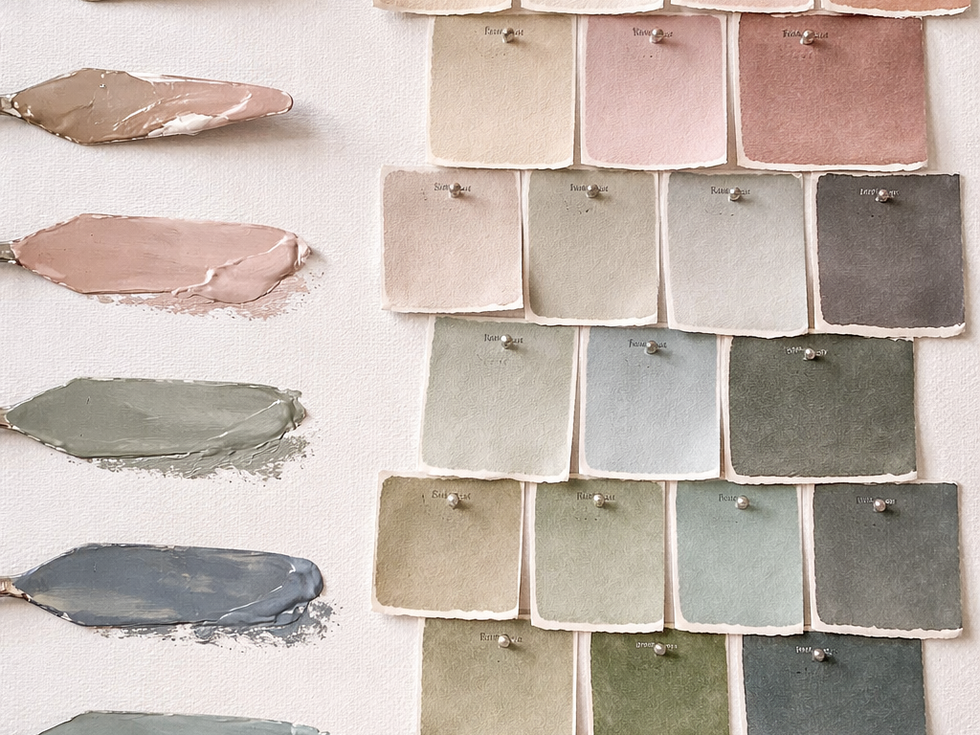
A calm, consistent colour palette with muted tones reduces visual stimulation. Too many competing colours, patterns or finishes in one room makes it harder for the eye to settle.
Matt, natural finishes are easier on the eye than high-gloss or reflective surfaces, which create visual movement and distraction.
Wall art and decorative objects work best when they are considered rather than accumulated. A single piece the eye can rest on is more supportive than a wall filled with frames.
Natural Materials and Focus: Why Wood, Plants and Views Help You Concentrate
This is where several things come together: what your surfaces are made of, what you can see from where you sit, and whether there is anything natural in the room.
Rooms with wood have been linked to lower blood pressure and reduced cortisol in several studies.
A field study published in the Journal of Experimental Psychology found that simply adding plants to a workspace improved productivity by 15%.
Research has found that workers with a pleasant view are 6 to 12% more productive than those without one.
Natural views support what researchers call attention restoration. When you look at something natural, like a tree or a plant, the brain rests without switching off. It recovers from the effort of focused work, so when you return to the task, you can concentrate more easily.
In practice, this means a wooden desk rather than a laminate one. A plant on the windowsill or within your line of sight. A window with a tree in it, or a piece of art with a natural scene if the view offers nothing green. Natural textures where your hands rest, linen, wood, wool, rather than synthetic surfaces.
These are not decorating choices. They are material choices that directly affect how calm and focused the brain can be in that space.
Colour and Focus: What Research Says About Blue, Green and Red
Colour affects cognitive performance more than most people expect.
A study published in Science found that blue enhances performance on creative tasks, while red improves accuracy on detail-oriented tasks.
Cool tones like blue and green help the brain stay focused without raising alertness to an uncomfortable level.
Green in particular has been shown to reduce stress and enhance relaxation.
For a workspace, this translates into practical choices. Muted blue or green tones on a feature wall or in soft furnishings around a desk create a calming backdrop that supports concentration. Warm neutrals like soft white, stone and sand work well as a base palette, keeping the room visually quiet without feeling sterile.
Avoid high-contrast or heavily saturated colours in the immediate workspace. They demand attention from the eye, which takes energy away from the task you are trying to concentrate on. If you want to introduce red, keep it small and intentional. A single object on the desk rather than a wall colour.

Desk Placement and Focus: How Layout Affects Productivity at Home
Where you position your desk matters more than you might think.
A study from UCL published in PLOS ONE found that workers with visual control over their environment were up to 40 times more likely to rate their productivity favourably.
Those at window desks felt more focused than those next to walls.
Those facing away from the room, with people or open space behind them, reported feeling less settled and less productive.
At home, the same principles apply. Sitting with your back to a door or an open room can create a low-level sense of unease that pulls focus. Facing a blank wall with no depth of view restricts your eye movement and can feel confining over long periods.
The strongest position for focus is one where:
Your back is against a wall or solid surface, not open space.
You have a view outward, whether that is a window, a room with depth, or at least a line of sight beyond your screen.
Your desk sits perpendicular to a window rather than directly facing it, so you get natural light without glare on your screen.
The space around your desk feels defined. A rug, a screen, a bookshelf or a change in lighting can create a boundary that tells the brain this is where focused work happens.
"Background speech can reduce performance on cognitively demanding tasks by up to 10%." - Journal of Environmental Psychology
Where to Start
Sit where you work and pay attention to what the room is doing.
Is the light warm and dim, or does it support alertness? Is there visual noise your brain is filtering in the background? Can you hear sounds that keep pulling your attention? Are the surfaces around you natural or entirely synthetic? Do your eyes have somewhere to rest that is not a screen?
You do not need to change everything. Start with the one thing that would make the biggest difference. Sometimes it is a single lamp, a cleared surface, or a plant placed where your eyes naturally land. One considered change can shift how you work in that room.
If you are interested in how evidence-based design can support the way you live and work at home, read more about how design affects anxiety, explore our Healing Design Framework, or start a conversation.


Comments